Are you asking the right questions? What we learned from our 2026 manufacturing events
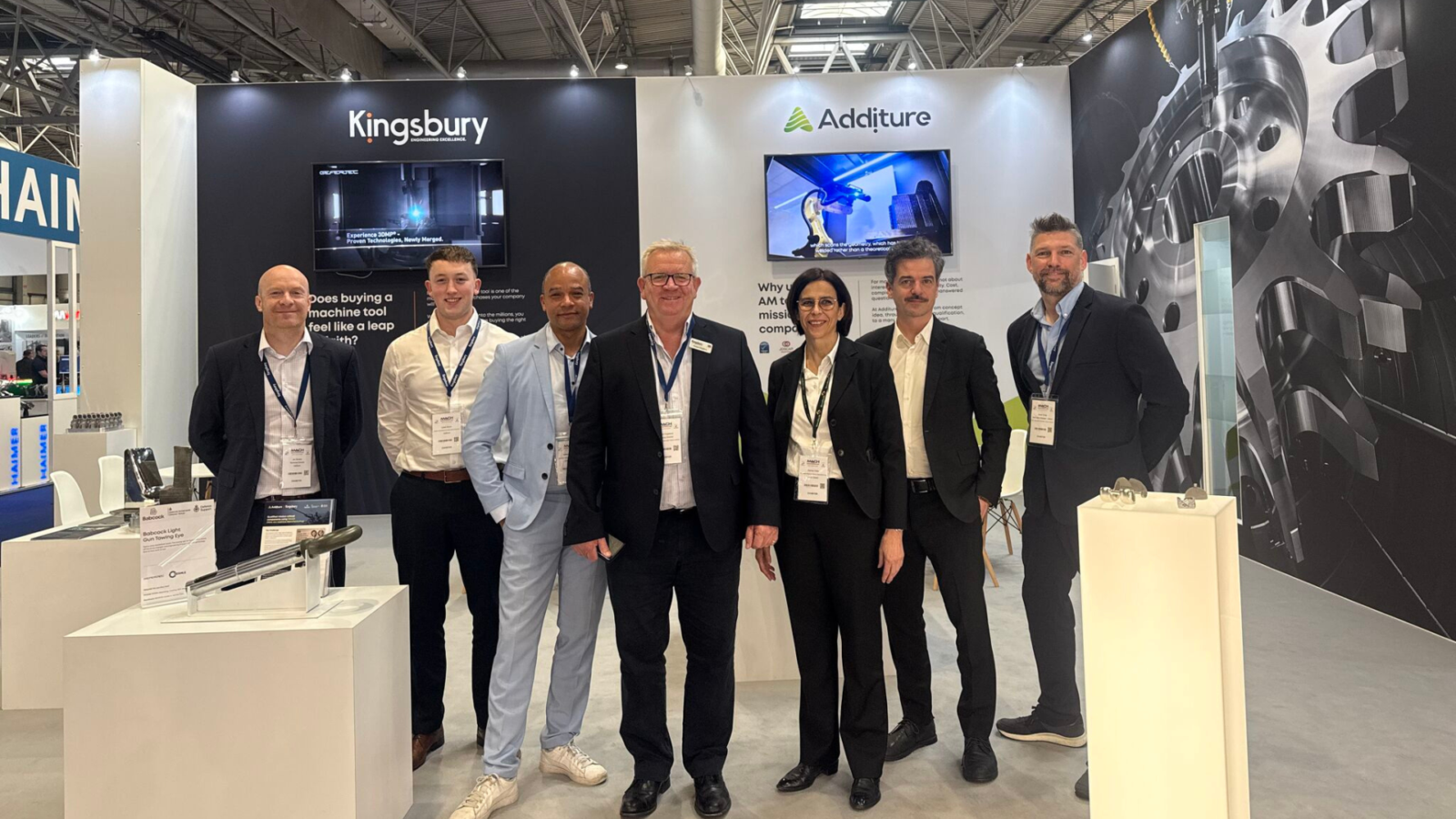
Kingsbury and Additure exhibiting at MACH 2026 with representatives from GEFERTEC and ATLIX.
With a range of events in the first quarter of 2026, including MACH Exhibition, the HERMLE Open House and Adelbert Haas GrindDate, our Area Sales Managers spent a lot of time engaging with customers.
Across these interactions, three themes consistently emerged: automation, integration, and performance. However, they also highlighted an important distinction.
While the HERMLE and Adelbert Haas events remained firmly focused on high-precision CNC machining across milling and grinding, the inclusion of additive manufacturing at MACH introduced a broader discussion around how emerging technologies sit alongside traditional manufacturing processes.
More importantly, these conversations revealed how different parts of an organisation approach these challenges from very different angles, especially as CNC automation and advanced manufacturing methods such as 3D printing continue to evolve. So, what were the key themes and questions our customers continued to discuss? How is this impacting investment decisions in 2026 and beyond?
The common theme: automation
Automation in CNC machining remains a major focus for manufacturers in 2026. Many discussions centred on improving spindle uptime, reducing manual intervention, and enabling more predictable production environments.
At the same time, there is growing curiosity around the capabilities of supporting technologies, such as 3D printing. For some, this raises questions around application fit, hybrid manufacturing strategies, and where additive processes complement, or sometimes compete with, traditional machining.
And while interest across both areas is high, clarity is not always there. As one of our Area Sales Managers observed, customers are asking more questions about automation and integration, but these questions are not necessarily carried through all internal teams.
Questions we heard most…
While each business is different, the questions being asked tended to fall into three distinct categories:
Engineering teams:
- What are the full capabilities of this CNC automation system?
- Where does 3D printing offer a viable alternative or complement to machining?
- How flexible are these technologies across different applications?
- Can automation integrate with our existing machines and digital infrastructure?
Operations teams:
- How stable is CNC automation in day-to-day production?
- What level of operator input is still required?
- How will this impact workflow, scheduling, and uptime?
- Where does additive manufacturing fit into our current process without disrupting output?
Finance teams:
- What is the return on investment for CNC automation?
- How do we justify investment in newer technologies like 3D printing?
- What are the total costs of ownership across both approaches?
- How quickly will we see measurable gains?
Each perspective is valid, but these teams often explore their questions in isolation, rather than as part of a unified strategy.
The question that we think is missing…
Despite the volume of discussions, one question was rarely asked at the outset:
“What problem are we actually trying to solve?”
Instead, conversations often begin with which solutions should be explored: should we use automation systems? What are the machine capabilities? What’s an emerging technology we can use?
These questions do not help define the problem, thus creating a risk.
If Engineering is focused on capability (including exploring 3D printing), Operations on stability, and Finance on ROI, then success may be defined differently across the business. Without alignment, even the most advanced solution can fail to deliver its full value holistically.
What our most successful customers are doing
The most successful manufacturers are not simply adopting new technology, but they think and understand how to apply this with clear intent.
CNC automation is delivering measurable benefits where the goal is increased utilisation, repeatability, and labour efficiency.
3D printing is proving valuable where complexity, material efficiency, or flexibility from low batch size are key drivers.
However, when these technologies are considered without a clearly defined and shared objective, decisions can be fragmented, and capability is prioritised over necessity.
Based on what we’ve seen so far in 2026, a more effective approach is to align on a core set of questions before evaluating solutions:
- What problem are we solving?
- Where does the problem we are solving sit? Is this a capacity issue, a consistency issue, or a cost issue?
- Where does CNC automation provide the best return?
- Where, if at all, does 3D printing add value to our process?
- What does success look like across engineering, operations, and finance?
- How will we measure the impact of any investment?
By addressing these questions early, businesses can ensure that conversations remain focused towards the key output: keeping the part front of mind.
If you want to know whether you’re asking the right questions, getting in touch with a Kingsbury ASM might be a good start.